Everything You Need to Know About Shipping Container Delivery in Canada
Dec
Everything You Need to Know About Shipping Container Delivery in Canada
Buying a shipping container is only the first step. One of the most important parts of the purchasing process is ensuring your container arrives safely, efficiently, and exactly where you need it. Whether you’re purchasing a container for residential storage, a construction project, a farm, or a commercial property, proper delivery planning can save you time, money, and unnecessary complications.
At Target Box Container Sales, we provide reliable shipping container delivery throughout Canada. Our experienced logistics team works closely with customers to coordinate every aspect of the delivery process—from selecting the appropriate transportation method to ensuring your site is ready before the truck arrives.
Many customers purchasing a container for the first time have questions such as:
- How is a shipping container delivered?
- What type of truck is used?
- Will a crane be required?
- How much space does the delivery truck need?
- What kind of foundation should I prepare?
- Can containers be delivered during winter?
This guide answers all of these questions and more, helping you understand exactly what to expect before your delivery day.
Why Proper Delivery Planning Matters
Shipping containers are large, heavy steel structures that require specialized transportation equipment. Unlike standard freight deliveries, container deliveries involve careful planning, route coordination, and proper site preparation.
Taking the time to prepare your property before delivery offers several important benefits:
- Reduces the risk of delays
- Helps avoid additional transportation costs
- Ensures safe unloading and placement
- Protects your property from unnecessary damage
- Allows the container to be positioned correctly on the first attempt
With proper planning, most deliveries can be completed quickly and efficiently, allowing you to begin using your container immediately.
Understanding the Shipping Container Delivery Process
The delivery process begins long before the truck arrives at your property. At Target Box Container Sales, every order follows a carefully coordinated workflow designed to ensure a smooth customer experience.
Step 1: Order Confirmation
Once your order is placed, our team confirms the container size, condition, customization requirements, delivery address, and preferred delivery date.
During this stage, we also discuss any special requirements such as:
- Narrow driveways
- Rural access roads
- Steep slopes
- Limited turning areas
- Crane requirements
- Site restrictions
Gathering this information early allows us to choose the most suitable delivery equipment.
Step 2: Delivery Planning
Our logistics coordinators review your location and determine the safest delivery route.
Factors considered include:
- Road restrictions
- Bridge clearances
- Vehicle access
- Local regulations
- Weather conditions
- Seasonal road limitations
This planning helps minimize delays and ensures your container reaches its destination safely.
Step 3: Scheduling Your Delivery
Once transportation arrangements have been finalized, you’ll receive a scheduled delivery window.
Our team provides updates leading up to the delivery date so you know when to expect the driver.
For larger commercial projects, deliveries can also be coordinated with contractors, site managers, or project supervisors.
Step 4: Transportation
Your container is loaded onto the appropriate delivery vehicle and transported to your location.
Depending on your property and project requirements, delivery may be completed using:
- Tilt-bed trucks
- Flatbed trailers
- Crane trucks
- Heavy-haul transport equipment
The transportation method is selected based on container size, site conditions, and accessibility.
Step 5: Placement
Upon arrival, the driver carefully positions the container according to your instructions.
Proper placement is essential because moving a shipping container after delivery often requires additional equipment and expense.
Our goal is to ensure your container is positioned correctly the first time.
Shipping Container Delivery Trucks Explained
Different projects require different transportation methods. Choosing the correct equipment depends on the size of your container, delivery location, available space, and ground conditions.
The three most common delivery methods are:
- Tilt-bed delivery
- Flatbed delivery
- Crane-assisted delivery
Each offers unique advantages depending on the project.
Tilt-Bed Delivery
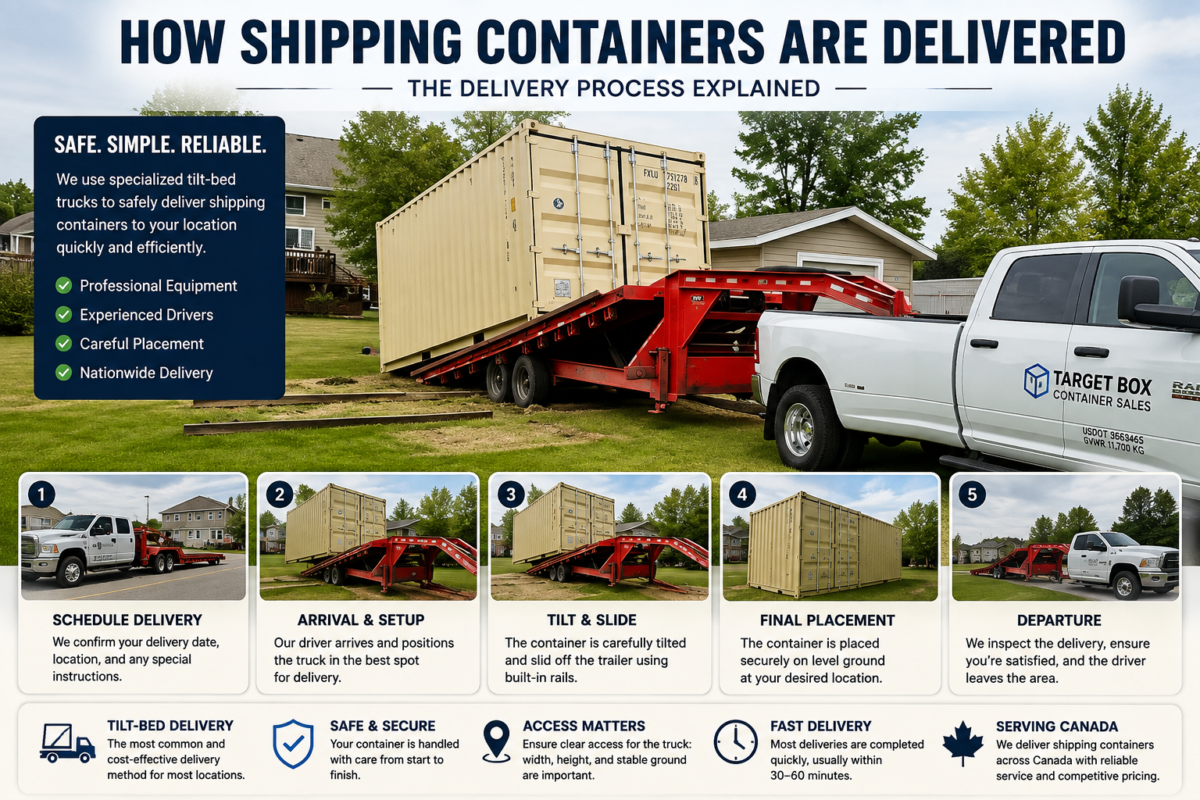
Tilt-bed delivery is the most common method used for residential and small commercial shipping container deliveries throughout Canada.
With this system, the truck bed tilts downward while the container slowly slides onto the prepared foundation.
Advantages
- Fast unloading
- No crane required
- Lower delivery costs
- Ideal for residential properties
- Minimal equipment required
Best Applications
- Homes
- Farms
- Workshops
- Small businesses
- Construction sites
Tilt-bed delivery is often the most economical option when there is sufficient space for the truck to maneuver.
Flatbed Delivery
Flatbed trailers are commonly used for transporting containers over long distances.
Unlike tilt-bed trucks, flatbeds require separate unloading equipment once they arrive at the destination.
This equipment may include:
- Forklifts
- Reach stackers
- Mobile cranes
Advantages
- Excellent for long-distance transportation
- Suitable for multiple container deliveries
- Efficient for commercial projects
Best Applications
- Industrial facilities
- Container depots
- Large construction projects
- Distribution centres
Flatbed transportation is frequently used when multiple containers are being delivered to the same location.
Crane Delivery
Some locations simply cannot accommodate a tilt-bed truck.
In these situations, crane-assisted delivery provides an effective solution.
A mobile crane lifts the container directly from the trailer and places it precisely where required.
Crane delivery is commonly used when containers need to be installed:
- Behind buildings
- Over fences
- Between structures
- On rooftops
- On elevated foundations
- In tight urban environments
Advantages
- Precise placement
- Access to difficult locations
- Ideal for modular construction
- Minimal ground disturbance
Although crane delivery generally costs more than tilt-bed delivery, it provides unmatched flexibility for challenging sites.
